 Skip to content
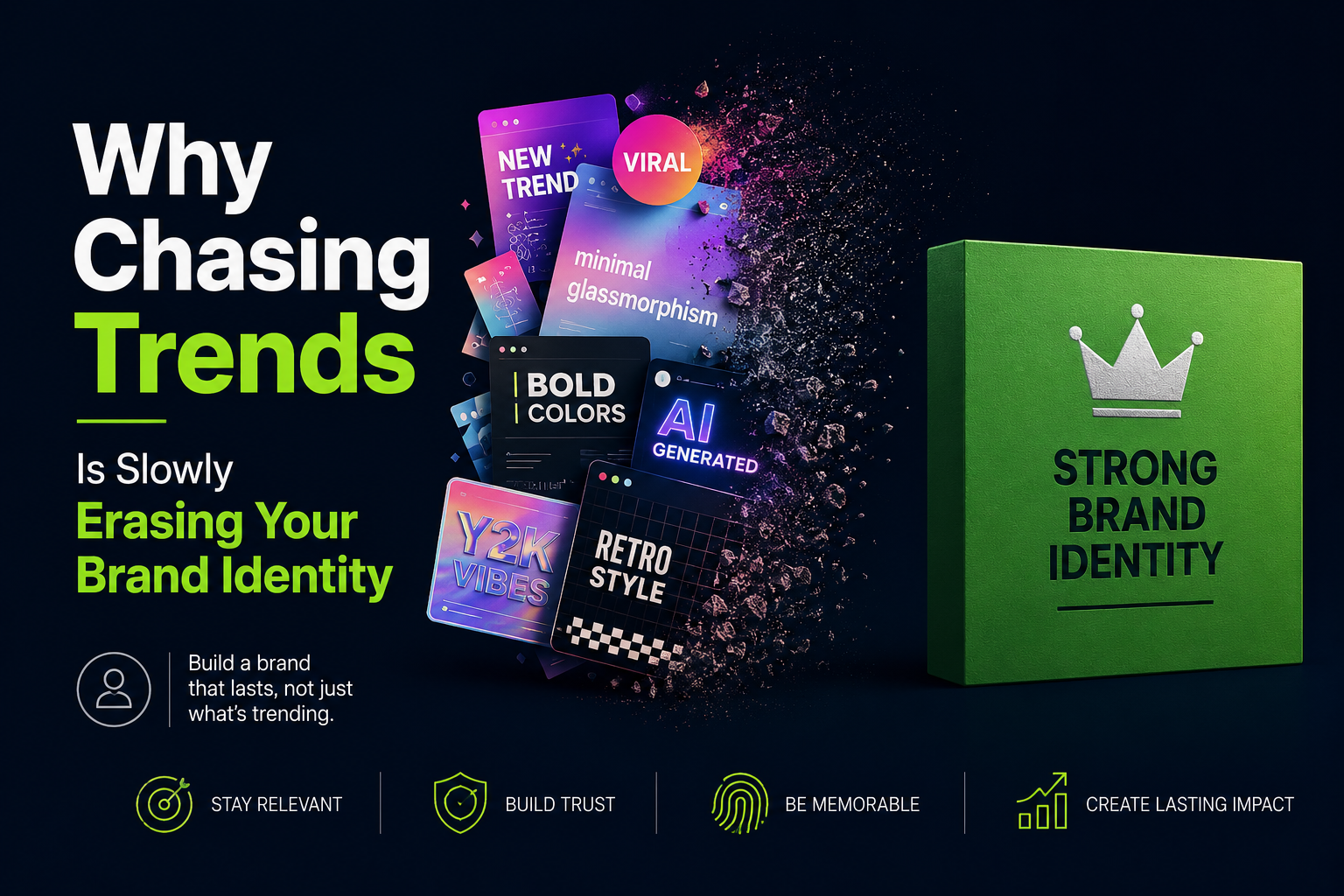
There is nothing wrong with staying current. The problem is when “staying current” becomes your strategy.
Brands that constantly chase trends — redesigning around whatever aesthetic is performing well, pivoting their voice to match what’s going viral, borrowing the energy of whatever cultural moment is happening — end up looking like everyone else at the exact moment they needed to stand out.
Worse, they end up looking like no one in particular. And customers don’t build loyalty with brands they can’t remember.
What Trend-Driven Branding Actually Looks Like
It starts reasonably enough. A brand notices a visual trend—a particular color palette, a typography style, an illustration treatment—that’s getting strong engagement. They update their content to match. It works for a few weeks.
Then the next trend arrives. They adapt again. And again.
A year later, their Instagram grid is a record of aesthetic pivots. Their brand fonts have changed twice. Their logo has been “refreshed.” Their tone has swung from warm and conversational to bold and minimal to quirky and self-aware. Each individual decision made sense at the time. The cumulative effect is a brand with no real identity at all.
Why Recognition Requires Repetition
Brand recognition is built through repetition over time. The more times a customer encounters the same visual language, the same tone, the same feeling — the deeper the memory trace becomes. Recognition leads to familiarity. Familiarity leads to trust. Trust leads to purchase.
Every time a brand changes its look or voice to chase a trend, it resets part of that process. The recognition that was building gets interrupted. The customer who was beginning to feel familiar with your brand now has to recalibrate.
Do this often enough and the recalibration never completes. Your brand stays permanently unfamiliar — which means permanently untrustworthy.
The Difference Between Evolution and Imitation
Strong brands do evolve. They update their visual systems, refresh their tone, and adapt to cultural shifts. The difference is that they evolve from the inside out — from a stable core identity — rather than from the outside in, chasing whatever is popular.
An evolution says: we know who we are, and we’re expressing that more clearly for where the world is now.
Imitation says: we’re not sure who we are, but that brand seems to be working, so let’s look like them.
Customers can feel the difference, even when they can’t name it.
How to Stay Relevant Without Losing Yourself
The answer is not to ignore trends. The answer is to filter them through your identity rather than replacing your identity with them.
Start by having a clear enough sense of your brand — visually and verbally — that you can evaluate any trend against it. Does this fit who we are? Does this express something we genuinely stand for? Or does this just look good right now?
Trends that genuinely align with your identity can be incorporated thoughtfully. Trends that don’t belong to you should be left alone, even if they’re currently everywhere.
The brands that age well are not the ones that looked most current in any given year. They are the ones that looked most like themselves, consistently, year after year.
How This Connects to Your Other Branding Decisions
Trend overreliance rarely exists in isolation. It almost always grows in the space left by two other failures: an unclear visual identity that gets replaced by whatever looks good right now, and an unclear brand voice that gets replaced by whatever tone is currently getting engagement.
If either of those foundations is weak, trend-chasing fills the gap — and makes both problems harder to solve.
We cover visual identity in our post on why inconsistent visual identity quietly destroys brand trust, and brand voice in our post on why an unclear brand voice costs you customer loyalty. Together, these three mistakes form what we call the Identity cluster — the group of branding failures that prevent a brand from ever becoming genuinely recognisable.
For the complete picture of how all nine branding mistakes connect — and how fixing them together creates lasting trust — read the full guide to the branding mistakes that quietly kill customer trust.
